
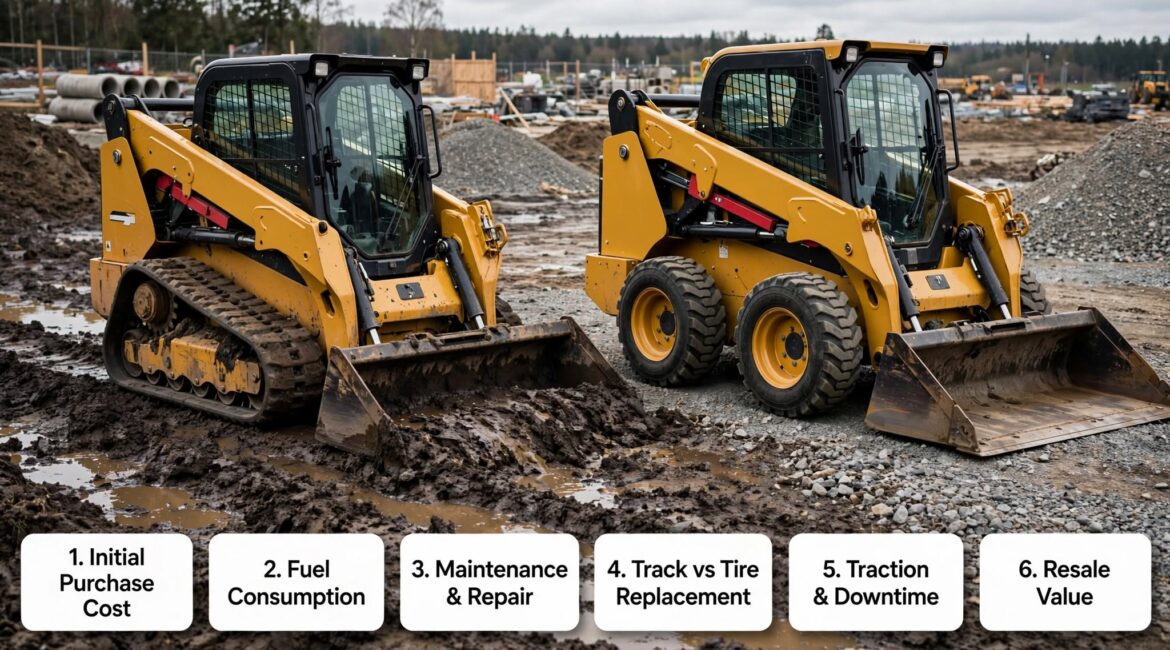
Skid steer tracks vs tires is a choice every equipment buyer faces. This critical decision affects every job. It affects your upfront purchase price, your daily running cost, and your eventual resale value.
Table of Contents
When weighing skid steer tracks vs tires, they perform completely differently. Tracks float effortlessly over soft ground. Tires aggressively grip hard surfaces. Tracks cost more upfront, while tires cost less to replace. The wrong choice wastes your money; the right choice makes you money.
This guide covers 6 essential cost factors to settle the skid steer tracks vs tires debate. Each factor drastically affects the total cost of ownership. The numbers will decide the winner.
In the battle of skid steer tracks vs tires, tracks cost more upfront. A tracked machine costs 10 to 20 percent more than an equivalent wheeled model. The track undercarriage adds massive complexity—rollers, idlers, and sprockets—which directly adds cost.
A wheeled skid steer costs less because the machine is simpler to build. New large skid steer prices range from $80,000 to $100,000, and a tracked version of the same machine costs $8,000 to $20,000 more.
Consider financing. A $15,000 price difference over 60 months at 6 percent interest costs you $290 extra per month. That is $3,480 in interest over the loan term. A tracked machine costs more before it works a single hour.
Insurance companies also charge more for tracked machines because the replacement value is higher, adding $1,000 to $2,000 over five years.
The winner for purchase price is tires. Lower upfront cost, lower financing, and lower insurance.
Both components wear out, making replacement a major factor when comparing skid steer tracks vs tires.
Track Replacement
Rubber tracks cost $1,500 to $4,500 per set. They generally last 1,200 to 1,600 hours.
Tire Replacement
A full set of four tires costs $400 to $3,200. Tires generally last 600 to 1,000 hours.
Calculate cost per hour. A $3,500 track set lasting 1,400 hours costs $2.50 per hour. A $1,500 tire set lasting 800 hours costs $1.88 per hour. However, this calculation changes with ground conditions. Rocky ground cuts tracks fast, while sharp gravel destroys tires instantly.
The winner for replacement cost is tires. Lower cost per hour and lower cost per replacement.
Analyzing skid steer tracks vs tires requires looking at weekly labor. Tracks need more maintenance. Track tension needs weekly checks. Rollers, idlers, and sprockets wear out and require greasing. This labor adds up.
Tires need less maintenance. You check air pressure, look for cuts, and rotate them if needed. Tires have no tension to check or rollers to grease.
| Maintenance Type | Tracks (Annual Cost @ $75/hr) | Tires (Annual Cost @ $75/hr) |
|---|---|---|
| Weekly Checks/Greasing | 20 Hours = $1,500 | 4 Hours = $300 |
Downtime also costs money. A track failure takes much longer to repair than swapping a tire. The winner for maintenance cost is tires. Less maintenance, less repair, and less downtime.
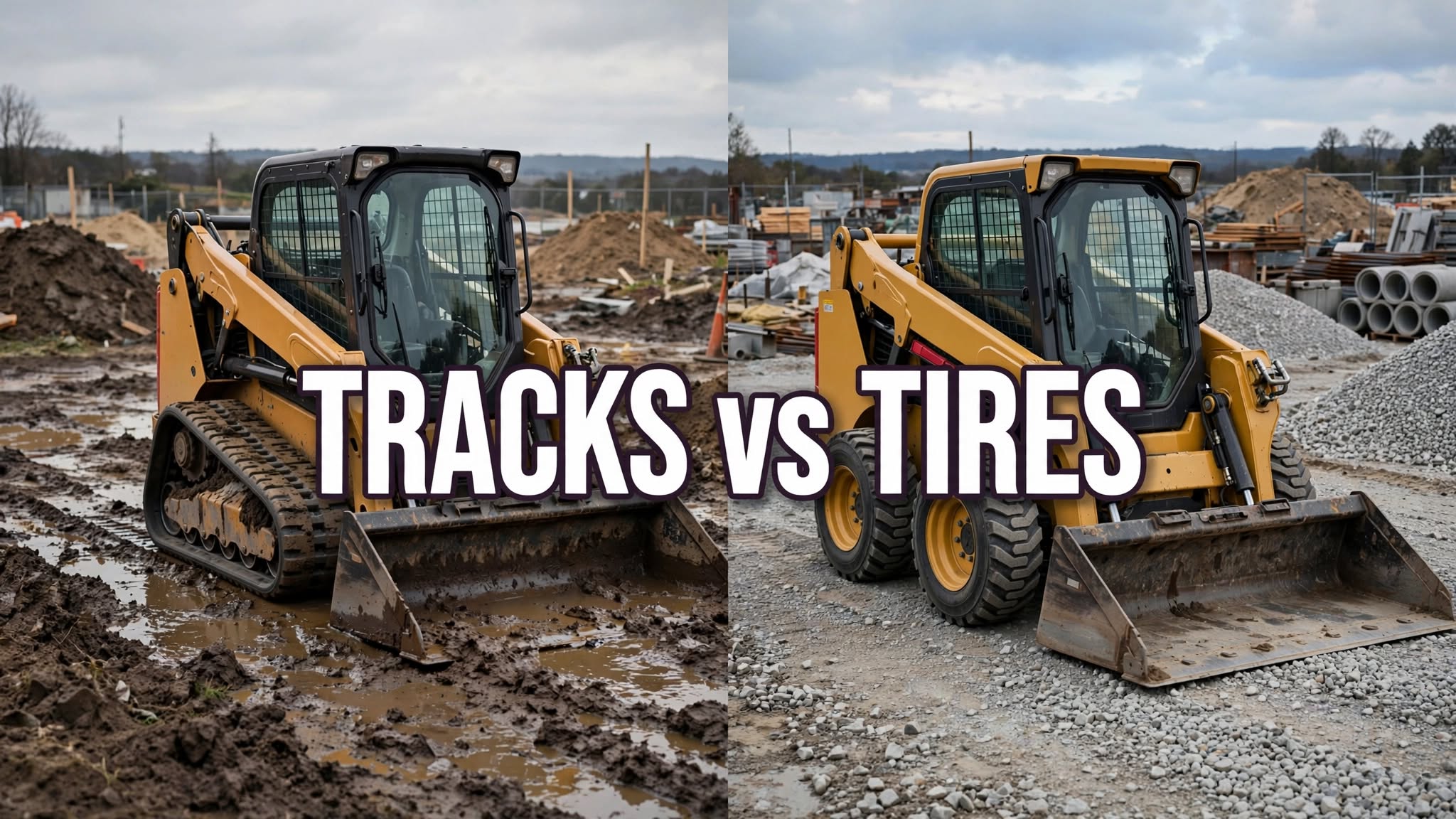
When measuring skid steer tracks vs tires, tracks simply burn more fuel. A tracked machine burns 2.5 to 3.5 gallons per hour. A wheeled machine burns 2 to 3 gallons per hour.
The track undercarriage creates massive drag as tracks roll over idlers. Over 1,000 hours, the difference is 500 gallons. At $4 per gallon, the tracked machine costs $2,000 more in fuel alone. Over 5,000 hours, that is $10,000 wasted.
The winner for fuel consumption is tires. Less drag, less fuel, and less overall operating cost.
Tracks cause far less surface damage. The track spreads the machine’s weight, keeping ground pressure low so the machine does not rut soft ground or tear up turf.
Tires concentrate weight on four tiny points. Ground pressure is high, causing tires to leave deep ruts in soft ground and black marks on pavement.
Surface damage costs real money. A damaged lawn costs $500 to $2,000 to repair. A scratched parking lot costs $1,000. Landscapers who damage lawns lose clients; those who protect them get referrals. In this phase of the skid steer tracks vs tires debate, the winner is tracks. Less damage means fewer client complaints.
Resale value affects the total cost of ownership in the skid steer tracks vs tires conversation. Tracked machines have incredibly strong resale demand from landscapers and agricultural buyers. However, worn tracks severely reduce this value.
Wheeled machines appeal to a broader buyer pool because tires are cheaper and easier to inspect.
The winner for resale value is a tie. Both hold value well depending on their operating condition and local market demands.
Counting the wins in the skid steer tracks vs tires debate:
- Purchase price: Tires win.
- Replacement cost: Tires win.
- Maintenance cost: Tires win.
- Fuel consumption: Tires win.
- Surface damage: Tracks win.
- Resale value: Tie.
The numbers favor tires for pure cost savings, but tracks dominate if you are working in soft, wet conditions.
The true winner of skid steer tracks vs tires depends on the terrain.
Hard surfaces: Concrete, asphalt, and gravel favor tires. They last longer and cost less.
Soft surfaces: Mud, sand, and snow favor tracks. Tires get stuck and cause downtime. Tracks keep you working and save money by preventing delays.
Example 1: Landscaping
An Ohio landscaper switched to tracks. Lawn damage claims dropped to zero, referrals increased, and revenue jumped 20%.
Example 2: Snow Removal
A Minnesota contractor uses tires on pavement. Tires grip pavement better, cost less, and don’t slip on ice like tracks.
The final decision on skid steer tracks vs tires comes down to the work you do. Hard ground favors tires. Soft ground favors tracks. If you are struggling with brush clearing regardless of your base, see how a skid steer brush cutter 5 reasons premium steel attachment can elevate your game.
Tires win on pure cost, while tracks win on capability. Run the numbers for your specific operation and calculate the annual cost to find the choice that makes you money.
If you’ve decided that a compact tracked machine is best for your soft-ground and landscaping needs, it’s time to look at premium equipment.
Explore the Typhon STOMP V950 Mini Skid Steer Track Loader →
[…] Many buyers find that if a machine only has 10 GPM but the mini skid steer trencher attachment needs 12 GPM, it digs slowly. Upgrading the hydraulics costs $2,000. Attempting to use standard teeth in rocky soil costs $1,800 per year in replacements. Replacing broken chains repeatedly adds $1,200. Total costs skyrocket when the wrong tool is selected. To understand how machine setup impacts overall costs, read our guide on skid steer tracks vs tires 6 costs. […]