Table of Contents
- Mistake 1: Skipping Daily Inspections
- Mistake 2: Using the Wrong Attachment Size
- Mistake 3: Leaving Attachments on the Ground
- Mistake 4: Hitting Concrete and Rocks
- Mistake 5: Overloading Attachment Capacity
- Mistake 6: Ignoring Maintenance Schedules
- Mistake 7: Using Wrong Hydraulic Flow Settings
- Mistake 8: Dropping Attachments From Height
- Your Attachment Lifespan Depends on You
Your attachment costs real money. A new hydraulic auger costs $3000. A new set of pallet forks costs $800. A new brush cutter costs $4500. You destroy one attachment and your monthly profit disappears due to mini skid steer operator mistakes.
You see it on job sites every day. Operators smash attachments into concrete. They drag buckets with worn cutting edges. They overload grapple buckets until steel bends. These mini skid steer operator mistakes cost you thousands.
This guide shows you eight common mini skid steer operator mistakes. Each of these mini skid steer operator mistakes destroys attachments. Each mistake has a fix. Learn these fixes and your attachments will last years longer, proving why a compact skid steer beats larger machinery when run by a skilled operator.
Running without an inspection is one of the worst mini skid steer operator mistakes. You skip the morning check. You attach your machine to a brush cutter. You work for four hours. A hydraulic hose fails. Oil sprays everywhere. The cutter motor runs dry and seizes.
A 2-minute inspection prevents this failure. Walk around your attachment every morning and look for these specific problems:
- Hydraulic Hoses: Check for cracks or bulges. Feel for soft spots or exposed wire mesh. Replace damaged hoses immediately.
- Quick Couplers: Check for dirt. A grain of sand inside a coupler scores the valve face, creating internal leakage and loss of power.
- Mounting Pins: Grab each pin and try to move it. A loose pin ovalizes the mounting plate and ruins the attachment forever.
- Cutting Edges: A bucket with a worn cutting edge puts stress on the bucket floor. Replace edges when they wear to 50% of original height.
- Grease Fittings: Pump grease into each fitting until old grease pushes out. A dry pin wears through the attachment frame.
A daily inspection takes just 2 minutes. Avoiding these mini skid steer operator mistakes saves you thousands in attachment repairs.
Using the wrong size is among the most common mini skid steer operator mistakes. You buy a heavy-duty brush cutter rated for a 5000-pound skid steer. Your machine weighs 2000 pounds. The brush cutter weighs 800 pounds, but you attach it anyway.
The weight hangs off your front plate. Your machine loses rear wheel traction. You cannot steer properly. You hit a rock, the brush cutter kicks back, and the impact bends your attachment mounting plate.
Every attachment has a weight rating and a flow rating. Match the attachment weight to your lift capacity. If your machine lifts 700 pounds, do not use an attachment weighing 600 pounds. That leaves only 100 pounds for material.
Match hydraulic flow requirements. If your machine puts out 8 GPM, an attachment needing 15 GPM will run slow and lack power. You push harder to compensate, causing the attachment to overheat and fail. Check your compatibility guide and use only approved attachments. Ignore this rule and you commit one of the classic mini skid steer operator mistakes that break attachment frames.
Leaving equipment on the ground is another of the top mini skid steer operator mistakes. You finish your job, disconnect your auger, and leave it lying in the dirt. The ground is wet. You drive away.
Two weeks later you need the auger. The auger flighting is bent. Mud rusted the gearbox output shaft. Water entered the hydraulic motor, leaving the interior orange with corrosion.
An attachment left on the ground suffers multiple damage sources. Moisture enters hydraulic ports, dirt packs into grease fittings, and weight rests on vulnerable flighting or cutting edges. To avoid such mini skid steer operator mistakes, always store attachments on a pallet or attachment stand. Build a simple stand from 2×4 lumber to keep weight off cutting edges and allow air circulation underneath.
Cover hydraulic couplers with dust caps. Store attachments indoors when possible, or raise them off the ground and use a tarp with air gaps if storing outside.
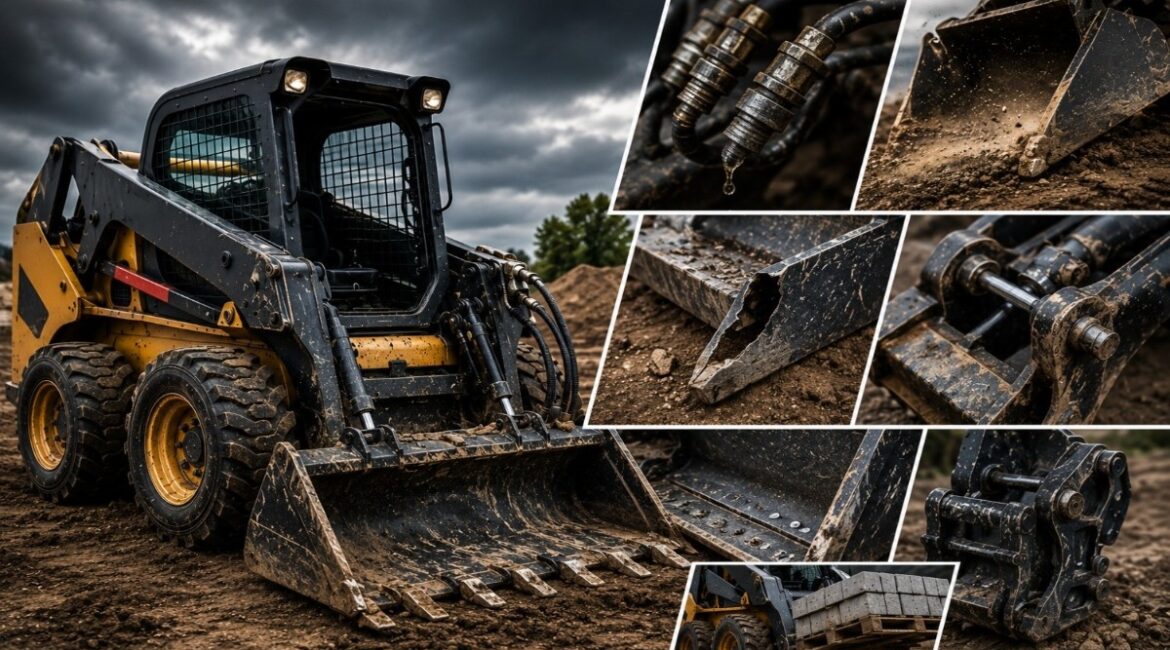
Hitting buried concrete is one of those sudden mini skid steer operator mistakes. You operate your machine with a landscape rake to level a yard. You hit a buried concrete chunk. The rake tines bend, but you keep working. Three more tines bend, and the rake frame twists.
A single impact with concrete or rock transfers shock through the attachment. The shock breaks weld joints, cracks hydraulic motor housings, and bends cylinder rods. Preventing these mini skid steer operator mistakes means using the correct attachment for each material.
| Material Type | Correct Attachment |
|---|---|
| Soil and small roots | Landscape Rake |
| Rocks and concrete chunks | Rock Bucket / Skeleton Bucket |
| Asphalt and concrete surfaces | Snow Push Blade (with rubber edge) |
Set your attachment height properly. Keep a 1-inch gap between cutting edges and hard surfaces. Float your attachment when working near obstacles so it follows ground contours instead of forcing impacts. Walk your job site before operating to mark rocks with spray paint.
Overloading capacity stands out among mini skid steer operator mistakes. You have a grapple bucket rated for 500 pounds. You pick up an 800-pound log. The grapple arms flex. You curl the bucket. The lower grapple arm bends and contacts the bucket floor. The grapple no longer closes.
Every attachment has a rated operating capacity. Exceed this rating and steel bends or breaks. Read the capacity plate on every attachment frame and cylinder. Learn to estimate material weight: a cubic foot of wet soil weighs 120 pounds. Fill a 5 cubic foot bucket, and you are already lifting 600 pounds.
Watch for deflection. Are your grapple arms bowing upward? That means overload. Remove material in layers instead of taking a full bucket in one pass. The extra minute saves your attachment from one of the most fatal mini skid steer operator mistakes.
Ignoring maintenance is one of the slow, silent mini skid steer operator mistakes. You buy a hydraulic post driver, use it for 200 hours, and never change the hydraulic motor oil. The motor fails. The repair costs $1200, while a new motor costs $1800.
Attachments need maintenance just like your loader needs oil changes. Create a maintenance log with these service intervals:
Every 10 Hours
Grease pins and bushings with lithium complex grease.
Every 40 Hours
Sharpen cutting edges with an angle grinder.
Every 50 Hours
Tighten all bolts to torque specs in the manual.
Every 100 Hours
Inspect welds for cracks. Stop-drill and weld if needed.
Every 250 Hours
Change hydraulic motor oil to the correct level.
Every 3 Years
Replace hydraulic hoses (or every 1000 hours).
Keep spare parts for each attachment (hoses, cutting edges, teeth, seal kits). You replace parts immediately to avoid further mini skid steer operator mistakes and extended downtime.
Using wrong hydraulic flow settings is one of the most technical mini skid steer operator mistakes. Your machine has a high flow option, but you run a standard flow auger and forget to switch the mode. The auger spins at double its rated speed, overheats, and strips the gears.
Too much flow destroys motors and pumps; too little flow makes attachments useless. To prevent such mini skid steer operator mistakes, set your flow control correctly. Standard flow attachments need 6 to 12 GPM. High flow attachments need 12 to 25 GPM.
Watch for a whining cavitation noise (low flow/air) or a screaming over-speed noise (too much flow). Adjust your engine RPM or switch to standard mode immediately to save the attachment.
Dropping attachments from a height is a prime example of careless mini skid steer operator mistakes. You back drag with your bucket, raise the bucket to clear a pile, and dump the load from 4 feet high. The bucket impacts the ground, cracking the hinge plate.
Dropping an attachment from any height shocks the entire frame. The shock transfers through pins to the attachment plate, cracking the weld joints. Always lower attachments to ground level before dumping. Use the float function to set the attachment gently, and pull back on the controls to dump material while resting on the ground.
Avoid back dragging with the cutting edge. Instead, flip your bucket to the angle position and use the back to spread force evenly. Lower engine RPM before contact for smooth, feathered control.
Eliminating mini skid steer operator mistakes depends on you. Daily inspections take 2 minutes. Matching attachment size takes one phone call to your dealer. Proper storage takes 5 minutes after each job. Avoiding obstacles takes simple awareness. Staying within weight limits takes a scale, and following maintenance schedules takes a log book.
Operators who follow these rules get 5000 hours from a bucket, 3000 hours from a brush cutter, and 10 years from pallet forks. Operators who ignore these rules buy new attachments every year, losing money and jobs while waiting for parts.
Train your crew on these mini skid steer operator mistakes. Post this list in your shop and review it every Monday morning. Your attachment budget will thank you.
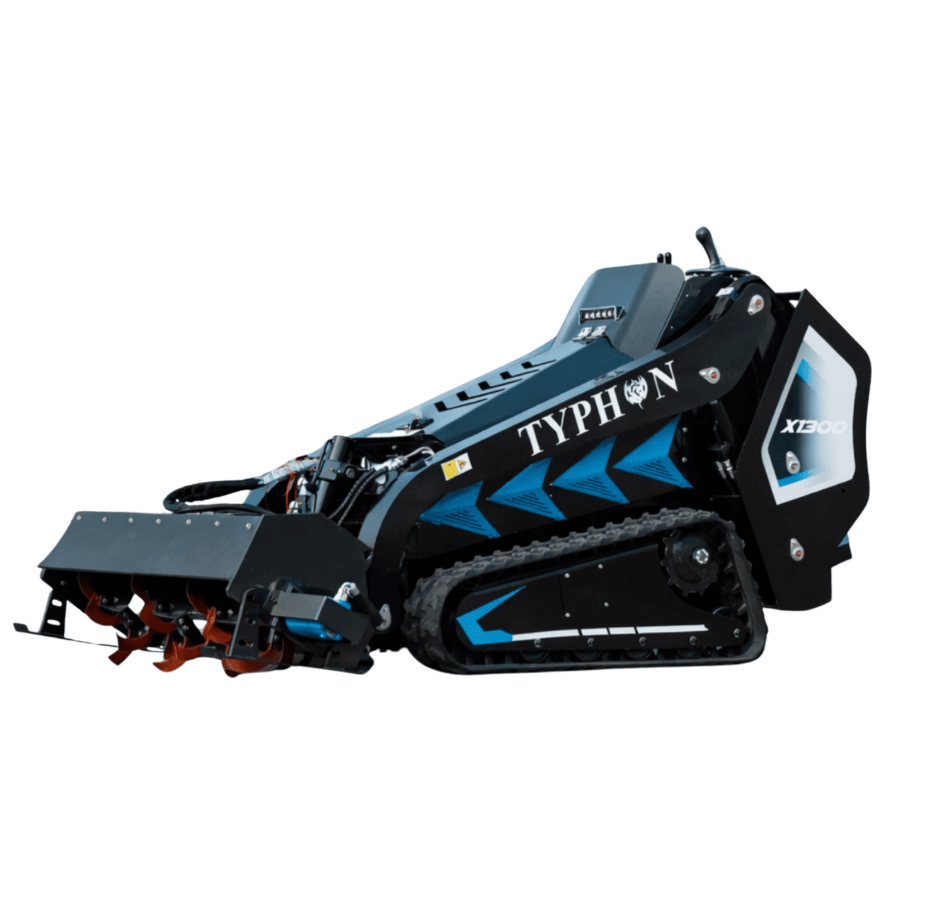
Stop paying for avoidable errors and upgrade to equipment built to withstand tough jobs. Check out the Typhon Stomp V1000 24HP Kubota Water-Cooled Diesel Skid Steer with precision pilot control to give your operators the smooth handling they need to protect their attachments.
View the Typhon Stomp V1000 →