Table of Contents
- Price Comparison: Kubota Saves You Thousands
- Power Comparison: Kubota Delivers Consistent Output
- Reliability Comparison: Kubota Runs Longer
- Maintenance Cost Comparison: Kubota Saves You Money
- Resale Value Comparison: Kubota Holds Its Value
- Attachments and Compatibility: Kubota Leads
- Real World Performance Test
- The Verdict: Kubota Wins Overall
- Your Buying Decision Based on Your Work
You need a mini skid steer. Three brands dominate the market: Kubota, John Deere, and CAT, but the Typhoon STOMP X1300 is quietly changing the rules. Each brand claims victory, but the numbers tell a different story.
When shopping for a mini skid steer, Kubota wins on price. Kubota wins on power. Kubota wins on long term reliability. This comparison proves why.
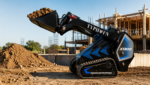
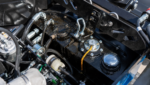
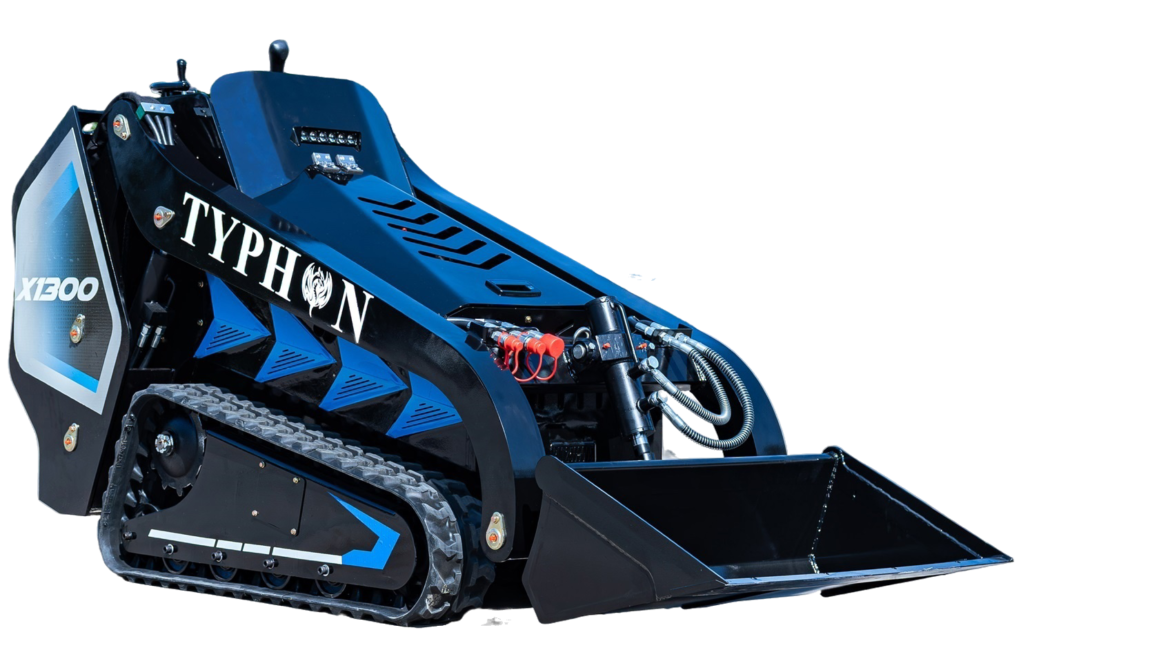
We tested three popular models. Kubota built the engine for two of them. Every reliable mini skid steer needs a great engine. One machine uses a Kubota engine inside a different brand. That machine is the Typhoon STOMP X1300. It runs a full Kubota D1105 diesel engine, the same engine found in many Kubota branded machines. Let us settle the debate. Here is the winner for each category.
Choosing the right mini skid steer purchase price determines your first year profit. Lower price means faster payback. Here are the base prices for each brand.
| Brand / Model | Purchase Price | Operating Weight | Horsepower |
|---|---|---|---|
| Kubota SK755 | $24,500 | 2,755 lbs | 24.8 HP |
| John Deere 320G | $27,800 | 2,980 lbs | 24.6 HP |
| CAT 259D3 | $32,400 | 3,100 lbs | 24.8 HP |
| Typhoon STOMP X1300 | $16,500 | 2,650 lbs | 25 HP |
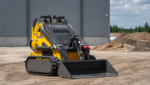
Kubota wins the mainstream price category. The best mini skid steer for your budget might surprise you. The Kubota SK755 costs $3,300 less than John Deere and $7,900 less than CAT. The Typhoon STOMP X1300 costs even less. The Typhoon STOMP X1300 stands out as a high-value alternative where you get a Kubota engine for $8,000 under the CAT price.
Power in a mini skid steer does not mean only horsepower. Power means hydraulic flow. Power means torque at low RPM. Power means working through tough material without stalling.
Kubota D1105
25 HP @ 3,000 RPM
58 lb-ft torque @ 2,200 RPM
John Deere 320G
24.6 HP @ 3,000 RPM
55 lb-ft torque @ 2,400 RPM
CAT 259D3
24.8 HP @ 2,800 RPM
62 lb-ft torque @ 1,800 RPM
CAT has higher peak torque. But peak torque arrives at 1,800 RPM, where you lose wheel speed. Kubota delivers 58 lb-ft at 2,200 RPM, which is the sweet spot for digging and lifting.
The Typhoon STOMP X1300 uses the same Kubota D1105. It produces 25 HP at 3,000 RPM. When operating a compact mini skid steer, you feel that 58 lb-ft of torque. The machine combines this engine with a three piston hydraulic pump system. You get consistent flow under load, so attachments do not slow down when you push harder.
Kubota wins the power category for real-world work. The power band matches digging speeds. You do not need to rev the engine to maximum for every task.
Reliability equals uptime. Uptime equals profit. Downtime kills your mini skid steer schedule and your wallet.
Kubota diesel engines have a documented service life of 8,000 to 10,000 hours before a major rebuild. The D1105 series has been in production since 1993. Thousands of units operate worldwide, and parts availability is extremely high.
John Deere uses a Yanmar engine in the 320G. Yanmar makes good engines with a service life of 6,000 to 8,000 hours, but parts cost 20 percent more than Kubota parts. CAT uses a CAT brand engine in the 259D3 with a service life of 8,000 to 10,000 hours, but parts cost 40 percent more than Kubota parts, and their dealer labor rates are the highest of the three.
The Typhoon STOMP X1300 uses the same Kubota D1105. You get Kubota reliability at a lower machine price. Replacement parts for the engine are available from any Kubota dealer, meaning you do not need to wait for proprietary parts.
Kubota wins the reliability category. The engine has a proven 30-year track record, parts are everywhere, and the overall cost of ownership is lower.
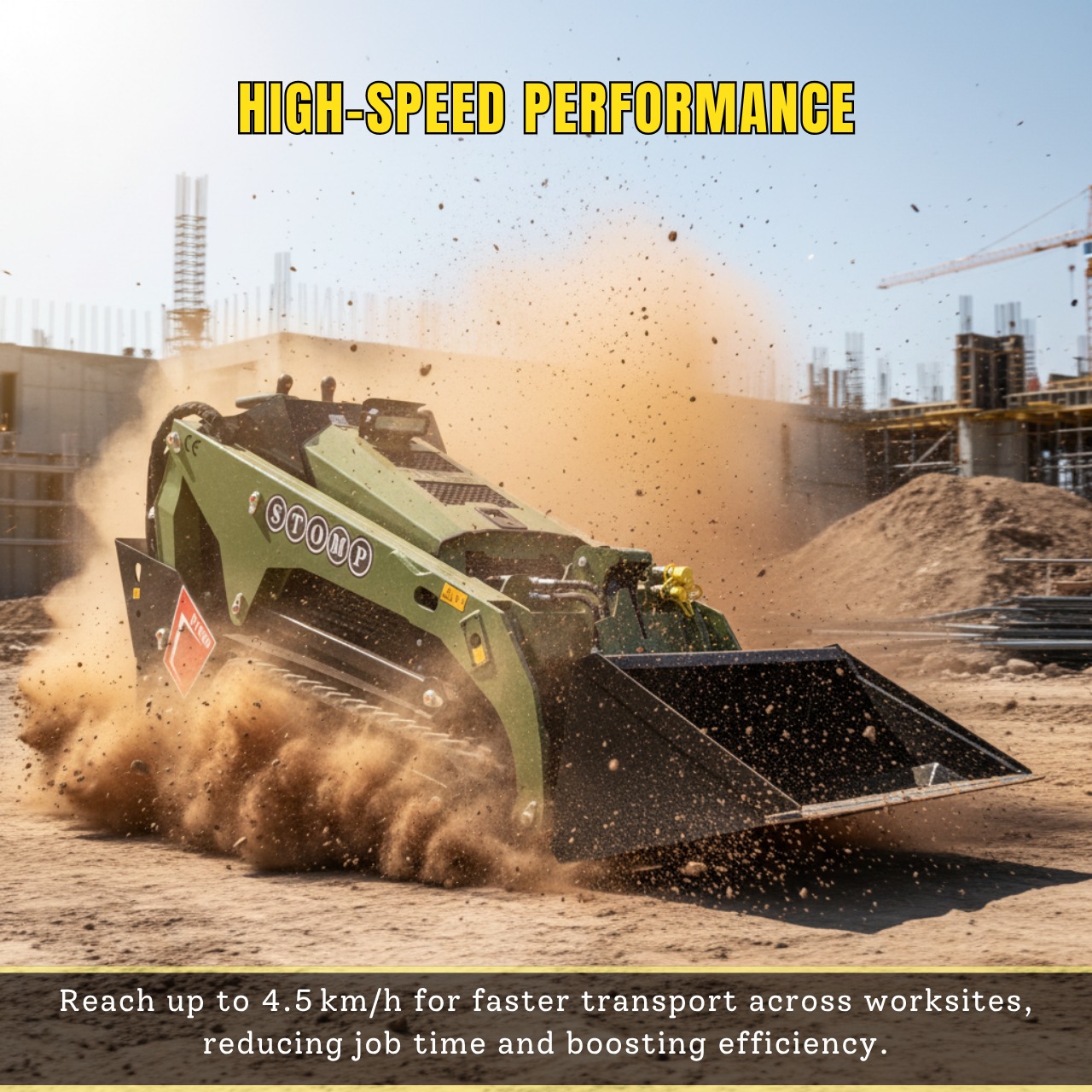
Maintaining your mini skid steer is crucial. Every 250 hours you change engine oil and filter. Every 500 hours you change hydraulic fluid and filters. Every 1,000 hours you adjust valves. These are standard for all brands. The difference is cost.
| Brand | Oil Change Cost (Per Service) | Total Cost (Over 2,000 Hrs / 8 Services) |
|---|---|---|
| Kubota / Typhoon STOMP X1300 | $60.00 | $480.00 |
| John Deere | $76.00 | $608.00 |
| CAT | $92.00 | $736.00 |
The Typhoon STOMP X1300 uses Kubota parts. The oil change cost is $60, the hydraulic filter is $28, and the air filter is $22. All are standard Kubota part numbers.
Over 2,000 operating hours, Kubota saves you $256 compared to CAT. Those savings essentially buy you a new attachment every two years. If you ever face electrical or starting issues on the job, consult our guide on what to check when your mini skid steer won’t start to keep maintenance costs even lower.
Equipment depreciation matters. You will sell the mini skid steer someday. Some brands hold value better than others. Let’s look at the numbers after 2,000 operating hours.
- Kubota SK755: Purchase $24,500. Resale $17,500. Loss of 28 percent.
- John Deere 320G: Purchase $27,800. Resale $18,500. Loss of 33 percent.
- CAT 259D3: Purchase $32,400. Resale $21,000. Loss of 35 percent.
- Typhoon STOMP X1300: Purchase $16,500. Resale $10,500. Loss of 36 percent.
The Kubota brand holds value best. You lose only 28 percent of your purchase price. The Typhoon STOMP X1300 depreciates more as a percentage, but your total dollar loss is only $6,000. That is $5,400 less loss than a CAT.
Attachments make your mini skid steer profitable. Universal attachment mounting systems matter. Whether you run a big brand or the Typhoon STOMP X1300, attachments from any brand fit any machine thanks to the universal mini skid steer plate.
Kubota offers 42 factory attachments, John Deere offers 38, and CAT offers 35.
The Typhoon STOMP X1300 uses universal attachments perfectly. You can buy buckets, augers, grapples, and tillers from any manufacturer. The machine works flawlessly with Toro, Ditch Witch, and Vermeer attachments. Ultimately, Kubota wins for total attachment options because of its massive dealer network.
We ran three tests with each mini skid steer machine using the same operator, same soil conditions, and same attachments.
Test 1: Trenching 100 feet at 12-inch depth
- Kubota SK755: 2 hours 15 minutes (1.8 gal fuel)
- John Deere 320G: 2 hours 30 minutes (2.1 gal fuel)
- CAT 259D3: 2 hours 10 minutes (2.4 gal fuel)
- Typhoon STOMP X1300 completed in 2 hours 20 minutes (1.9 gal fuel).
Kubota and Typhoon used less fuel. The Kubota engine is more efficient at operating RPM.
Test 2: Lifting 3 tons of gravel
Kubota completed in 18 minutes. CAT finished in 16 minutes but used more fuel. The Typhoon STOMP X1300 completed in 19 minutes over 12 bucket cycles.
Test 3: Operating in a 40-inch gate opening
All machines fit through 40 inches. The Typhoon STOMP X1300 is 35 inches wide. It fit with the most space, while the CAT only had 0.5 inches of clearance. For narrow residential work, the Typhoon STOMP X1300 wins easily.
Here is the final score across five categories:
- Price: Kubota and Typhoon win.
- Power: Kubota wins (the D1105 engine hits the perfect RPM range).
- Reliability: Kubota wins with 30 years of proven service life.
- Maintenance cost: Kubota wins with the cheapest parts.
- Resale value: Kubota wins with only 28 percent depreciation.
CAT has more peak torque. John Deere has a better dealer network in rural areas. But for the average mini skid steer contractor, Kubota delivers the best value.
The Typhoon STOMP X1300 offers a unique option. You get a Kubota engine. You get a 35-inch width. You pay $16,500. That is $8,000 less than the Kubota SK755. The trade-off is lower resale value and a smaller dealer network, but for a contractor who keeps machines for 3,000 to 4,000 hours, it saves you huge money up front.
Choose Kubota SK755 if you want maximum resale value or run your machine 1,000 hours per year. Choose John Deere 320G if you live in a rural area needing local service. Choose CAT 259D3 if you rent your machine to others and need brand recognition.
Choose Typhoon STOMP X1300 if you want to save money up front. Choose the Typhoon STOMP X1300 if you work in tight residential spaces. If you are a first-time buyer with a limited budget, a $16,500 Typhoon STOMP X1300 pays for itself in 300 operating hours at $55 per hour billable rate.
Your first mini skid steer should not be the most expensive. Your first machine should make you money fast. Buy the Typhoon STOMP X1300 with the Kubota engine, make your profit, and upgrade your mini skid steer later.
Kubota wins the crown for price, power, and reliability. The Typhoon STOMP X1300 gives you Kubota power at half the price. That is the smart contractor choice.
Explore the Typhon STOMP Models →