Mini Skid Steer for Demolition: Break Concrete and Remove Debris Fast
Table of Contents
- Why it Works for Demolition
- Attachments for Breaking & Removing
- Breaking Concrete Techniques
- Removing Debris Effectively
- Time and Cost Comparison
- Safety Rules for Demolition Work
- Techniques for Different Materials
- Disposal Options for Debris
- Rent or Buy?
- Your Demolition Profit Calculator
- Common Mistakes to Avoid
- Real Demo Project Example
You have a concrete patio to remove. You have a driveway to tear out. You have a pool deck to demolish. You need a mini skid steer for demolition that fits through the gate. You need equipment that breaks concrete fast. You need equipment that hauls debris out quickly.
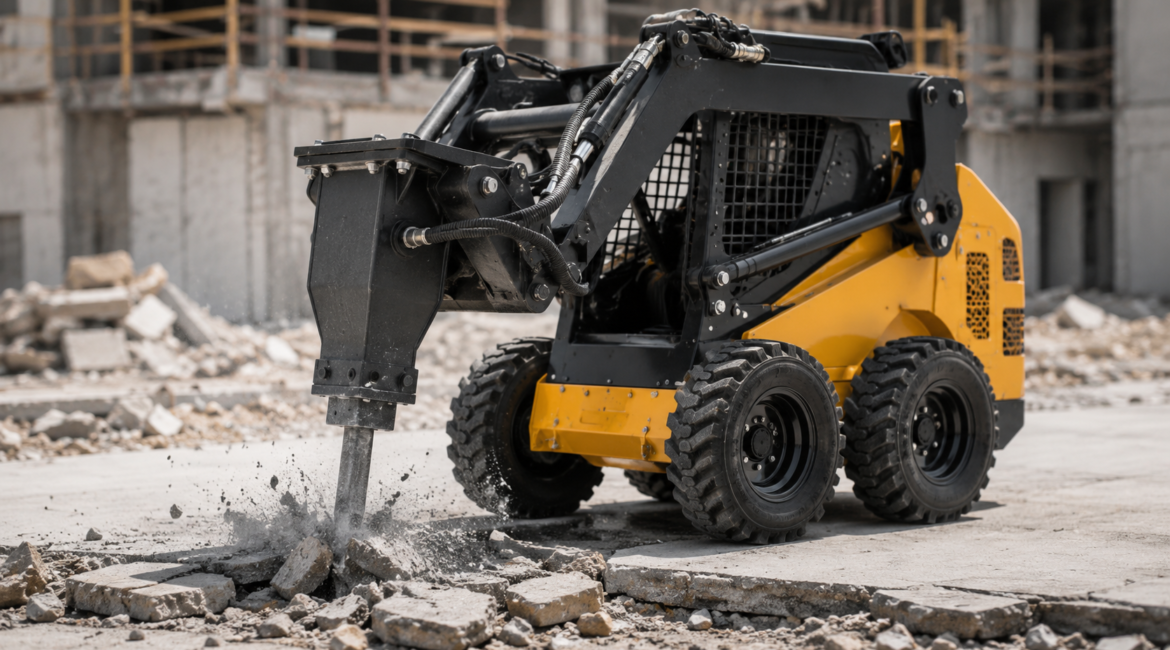
A full size skid steer is too wide for most backyards. Hand tools take too long. A mini skid steer for demolition solves both problems. The machine fits through standard gates. The machine breaks concrete with the right attachment. The machine loads debris into trucks and trailers.
This guide shows you how to use a mini skid steer for demolition. You learn the attachments. You learn the techniques. You learn the safety rules. You save time. You save money. You finish jobs faster than your competitors.
A mini skid steer for demolition is the right tool for residential work. The machine is narrow. The machine is powerful. The machine is maneuverable.
The Typhoon STOMP X1300 is 35 inches wide. It fits through 36 inch gates. Most residential backyards have 36 inch gates. Full size skid steers are 48 to 60 inches wide. They do not fit. Contractors with full size machines hand carry debris. Contractors with a mini skid steer for demolition move material by the bucket load.
The machine weighs 2,650 pounds. The mini skid steer for demolition has 25 horsepower. The machine has 2,800 PSI hydraulic pressure. That pressure powers hydraulic breakers. That pressure powers grapples. That pressure powers buckets.
You do the work faster. You bid on jobs that others refuse when equipped with a mini skid steer for demolition. You charge premium rates for tight access work.
You need the right attachment for each mini skid steer for demolition task. One attachment breaks concrete. One attachment grabs and sorts material. One attachment loads and hauls. One attachment cuts rebar.
- Attachment 1. Hydraulic breaker: The breaker attaches to the auxiliary hydraulic circuit. The breaker uses hydraulic pressure to drive a chisel. The chisel strikes concrete at 1,200 blows per minute. A 500 foot pound breaker breaks 4 inch thick concrete in one pass. The breaker costs $2,500. It pays for itself on the first large patio job.
- Attachment 2. Ripper tooth: The ripper tooth uses machine weight and hydraulic force to break material. It pries up concrete slabs, breaks asphalt, and loosens compacted soil. The ripper costs $500. It is the cheapest demolition attachment and works for light to medium demolition.
- Attachment 3. 4 in 1 bucket: The bucket has a clamshell function. The bottom opens and closes. You grab debris, load debris into the truck, and sort material by opening the bucket over a pile. The 4 in 1 bucket costs $2,500. It replaces a standard bucket and a grapple.
- Attachment 4. Grapple bucket: The grapple has a hydraulic arm that clamps down on material. You grab broken concrete chunks, tree stumps, and scrap metal securely. You carry more per load. The grapple costs $2,800.
- Attachment 5. Demolition bucket: The bucket has a straight cutting edge with teeth. The teeth break and scrape concrete. The demolition bucket costs $1,200. It is stronger than a standard digging bucket.
Step 1. Prepare the work area. Remove all furniture and debris. Mark utility lines. Call 811 for underground utility location. Never break concrete over gas or electric lines. This step saves your life.
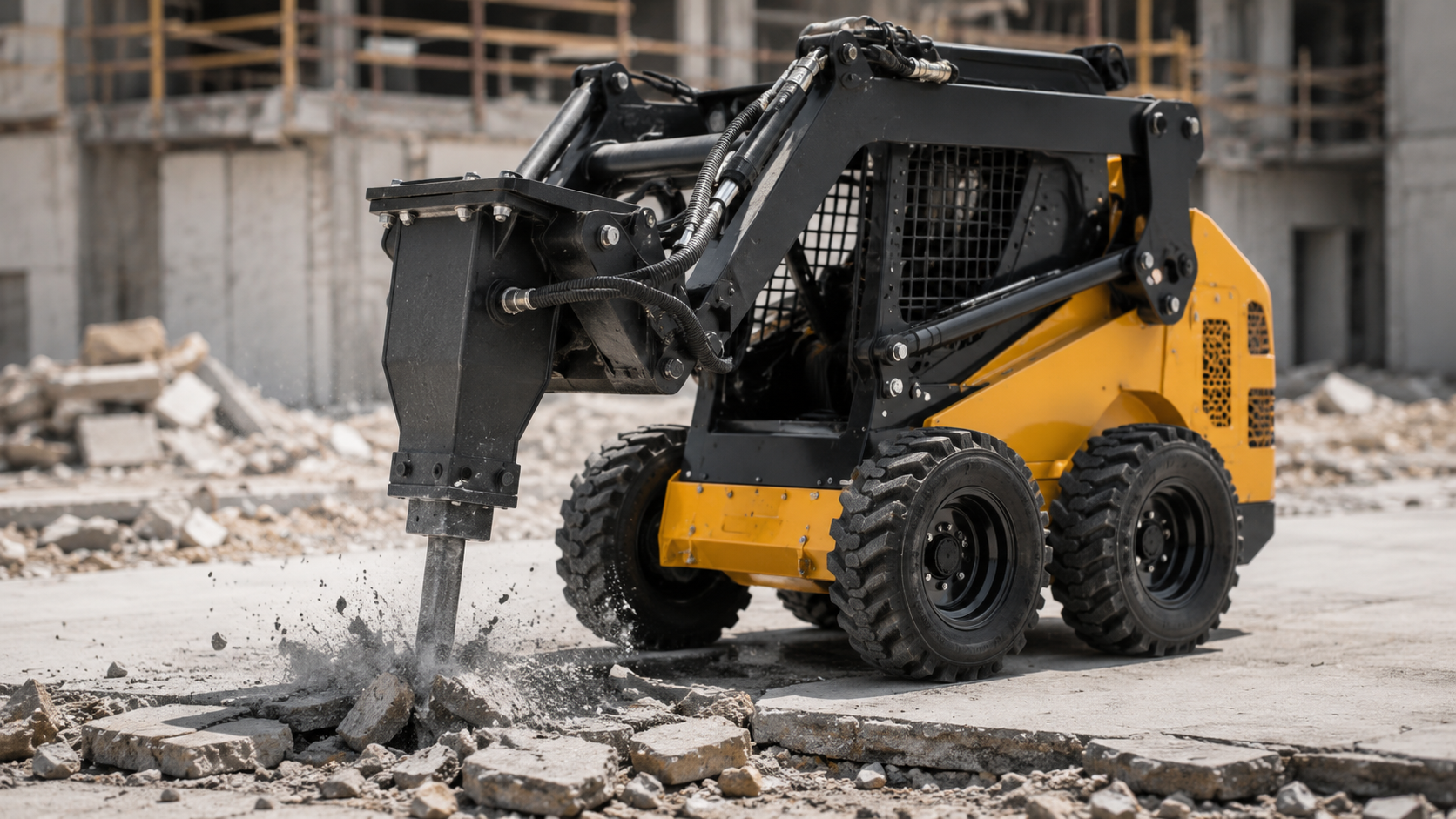
Step 2. Select the right breaker. Use a hydraulic breaker for slabs thicker than 4 inches. Use a ripper tooth for slabs thinner than 4 inches. Use a demolition bucket for asphalt and light material.
Step 3. Start breaking from the edge. The edge is the weakest point. Position the breaker at the edge. Angle the breaker slightly toward the slab. Engage the auxiliary hydraulic circuit. Move the breaker across the edge. Create a crack line.
Step 4. Break in sections. Work in 2 foot by 2 foot sections. Break each section completely. Move to the next section. This prevents large slabs from falling on the machine.
Step 5. Break to manageable pieces. Concrete pieces should be smaller than your bucket opening. The Typhoon STOMP X1300 bucket opening is 24 inches wide. Break concrete to 12 inch pieces. Pieces of this size fit in the bucket and load easily into trucks.
Step 6. Separate rebar from concrete. Rebar damages hydraulic breakers. Use a grapple to pull rebar out of broken slabs. Cut rebar with a portable grinder. Remove all rebar from the debris pile to make hauling easier.
Step 1. Load broken concrete. Tilt the bucket forward. Drive into the debris pile. Lift the bucket. The bucket holds 6 cubic feet of material. That is approximately 600 pounds of broken concrete.
Step 2. Transport debris. Drive the mini skid steer for demolition to the truck. Back up to the truck bed or trailer. Raise the bucket to truck height. The Typhoon STOMP X1300 has a 70 inch dump height that reaches standard dump truck beds.
Step 3. Dump the load. Tilt the bucket forward. The debris slides out. Repeat the load and dump cycle. A mini skid steer for demolition moves 3 tons of debris per hour. A hand crew moves 1 ton per day.
Step 4. Sort material. Open the clamshell over the truck bed. Concrete falls into the truck while separating from soil.
Step 5. Use a grapple. Broken slabs weigh up to 500 pounds. The grapple clamps on and you drag the piece to the truck to lift it into the bed.
Here is the comparison for a 500 square foot concrete patio demolition.
| Method | Time / Labor Cost | Total Cost (incl. disposal) | Timeline |
|---|---|---|---|
| Hand tool method | 48 hours @ $30/hr = $1,440 | $1,640 | 3 Days |
| Mini skid steer for demolition method | 14 hours @ $30/hr = $420 | $920 (incl. $300 rental) | 1 Day |
Rental cost for a mini skid steer for demolition is $300 per day. Savings with a mini skid steer for demolition is $720. Timeline savings is 2 days. You take more jobs. You finish more jobs. Your profit increases.
Demolition is dangerous work. Concrete dust irritates your lungs. Flying debris injures your eyes. Follow these rules.
- Rule 1. Wear PPE. Wear a hard hat, safety glasses with side shields, a dust mask, steel toe boots, high visibility vest, and gloves.
- Rule 2. Operate from the seat. Do not hold the breaker by hand. You stay protected inside the roll cage.
- Rule 3. Keep people away. Establish a 30 foot exclusion zone. Concrete chips fly 50 feet and cause severe injuries.
- Rule 4. Inspect attachments. Check the breaker chisel and hydraulic hoses. High pressure fluid causes injection injuries.
- Rule 5. Watch for overhead hazards. Watch for power lines, tree branches, and building overhangs.
- Rule 6. Use the seat belt. A mini skid steer for demolition rollover is possible due to the downward force of a breaker. The seat belt keeps you safely in the roll cage.
Concrete Slab
Break from the edge inward with a hydraulic breaker. Create a 2×2 grid.
Asphalt
Use a ripper tooth to pry up strips, then remove with the bucket.
Brick Wall
Start at the top with a hydraulic breaker. Let the brick fall inward.
Stucco & Plaster
Scrape the material off the wall using a demolition bucket with teeth.
For rebar reinforced concrete, use a hydraulic breaker for the concrete and a grapple to pull the rebar out, cutting it with a grinder.
You have broken concrete to remove. Here are your disposal options:
- Option 1. Dumpster rental. Cost is around $400 for a 10 yard dumpster.
- Option 2. Truck and trailer. Haul to a landfill. Fees average $30 per ton (a 10 cubic yard load costs ~$450).
- Option 3. Concrete recycler. Crush facilities accept concrete for lower fees; some even accept clean concrete for free.
- Option 4. On site reuse. Use broken concrete as fill in low areas covered with soil to avoid disposal fees.
Your first demolition job. Do you rent or buy?
Rent for one job. Weekly rental is $1,200. Breaker rental is $300 per day. Total rental cost for a mini skid steer for demolition for one week is $1,500. This works for occasional jobs to avoid maintenance and storage costs.
Buy for regular work. A Typhoon STOMP X1300 costs $16,500. A hydraulic breaker costs $2,500. Total purchase cost is $19,000. Payback period is 10 to 15 demolition jobs.
If you purchase used or standard equipment, make sure to read up on mini skid steer track replacement routines to maintain full pushing power during hard demolition tasks.
Use this formula to calculate profit on a demolition job:
- Job price: Bid $2,500 for a 500 square foot patio.
- Equipment cost: Rental $1,200 for the week plus breaker $300 per day = $1,500.
- Labor cost: Operator ($240) + Helper ($200) = $440.
- Disposal cost: Dumpster $400.
- Total cost: $1,500 + $440 + $400 = $2,340.
- Profit: $2,500 minus $2,340 equals $160.
This is a small profit. Owned equipment increases profit. A mini skid steer for demolition pays for itself quickly, eliminating the $1,500 rental fee and boosting profit on this job from $160 to $1,660.
Mistake 1. Breaking concrete in the center first. The center is thick and has no free edge. Always start at the edge.
Mistake 2. Overloading the bucket. Overloading causes tip over. Know your limit.
Mistake 3. Operating the breaker at low RPM. Run the engine at 2,800 to 3,000 RPM. Low RPM reduces breaker power.
Mistake 4. Not using water for dust control. Use a water hose to wet the concrete before breaking. Wet concrete produces less dust.
One contractor used a mini skid steer for demolition on a backyard pool removal. The pool was 20 feet by 40 feet. The concrete deck was 4 inches thick. The gate was 36 inches wide.
He used a Typhoon STOMP X1300 with a hydraulic breaker. He broke the deck in 6 hours and loaded the broken concrete into a dumpster in 4 hours. Total time was 10 hours. A hand crew estimated 5 days for the same work.
He quoted $6,000 for the pool removal. His costs were $2,000, leaving a profit of $4,000. The contractor now owns his mini skid steer for demolition. He does 12 pool removals per year. Profit from pool work is $48,000 annually. The machine paid for itself in 4 months.
A mini skid steer for demolition changes your business. You break concrete faster. You remove debris faster. You fit through tight gates. You bid on more jobs. You make more profit.
Use a hydraulic breaker for thick concrete, a ripper tooth for thin concrete, a 4 in 1 bucket for sorting, and a grapple for large pieces. Follow safety rules strictly.
Break concrete. Remove debris. Make money. A mini skid steer for demolition does all three.
View the Typhon Stomp V1000 24HP Kubota Water-Cooled Diesel Skid Steer →